
Can You See the Vikings in Britain's Place Names?
How Scandinavian place-name elements map across Britain, and why they cannot be treated as a simple record of Viking settlement.
By Alex Hill · 14 October 2026
Lincolnshire is crowded with names ending in -by. Cross the Pennines into Cumbria and -thwaite becomes much more conspicuous. Both endings came from Scandinavian speech, yet they draw different maps. Follow them north towards the Solway and the familiar picture of Vikings settling inside the Danelaw starts to look too small.
There is a historical footprint here. The difficulty is deciding whose footprint it is: the first settlers’, their descendants’, or people who carried on using their words.
A pattern worth taking seriously
Start with [Grimsby](https://www.etymap.co.uk/place/grimsby--osgb4000000074571038). Its name combines the personal name Grímr with bý, a farmstead or village. That reading is supported by the English Place-Name Society’s Lincolnshire survey, cited by the University of Nottingham’s [Vikings in the East Midlands project](https://emidsvikings.ac.uk/items/great-grimsby/). It does not require us to believe the later story of a fisherman called Grim founding the town.
Nearby Scunthorpe preserves another Scandinavian personal name, Skuma, with þorp: an outlying or dependent settlement, according to the [Lincolnshire historic-environment survey](https://heritage-explorer.lincolnshire.gov.uk/eusreports/scunthorpeeusreport-compressed.pdf). Behind two industrial towns are words for much smaller places.
These are not isolated curiosities. Yorkshire, Lincolnshire and the East Midlands contain substantial concentrations of Scandinavian names. But the Danelaw was never linguistically uniform: the [Society for Name Studies in Britain and Ireland](https://www.snsbi.org.uk/exploring-names/place-names-of-england/) notes much weaker influence in Suffolk than in Yorkshire, Lincolnshire or Norfolk, and very little in Essex.
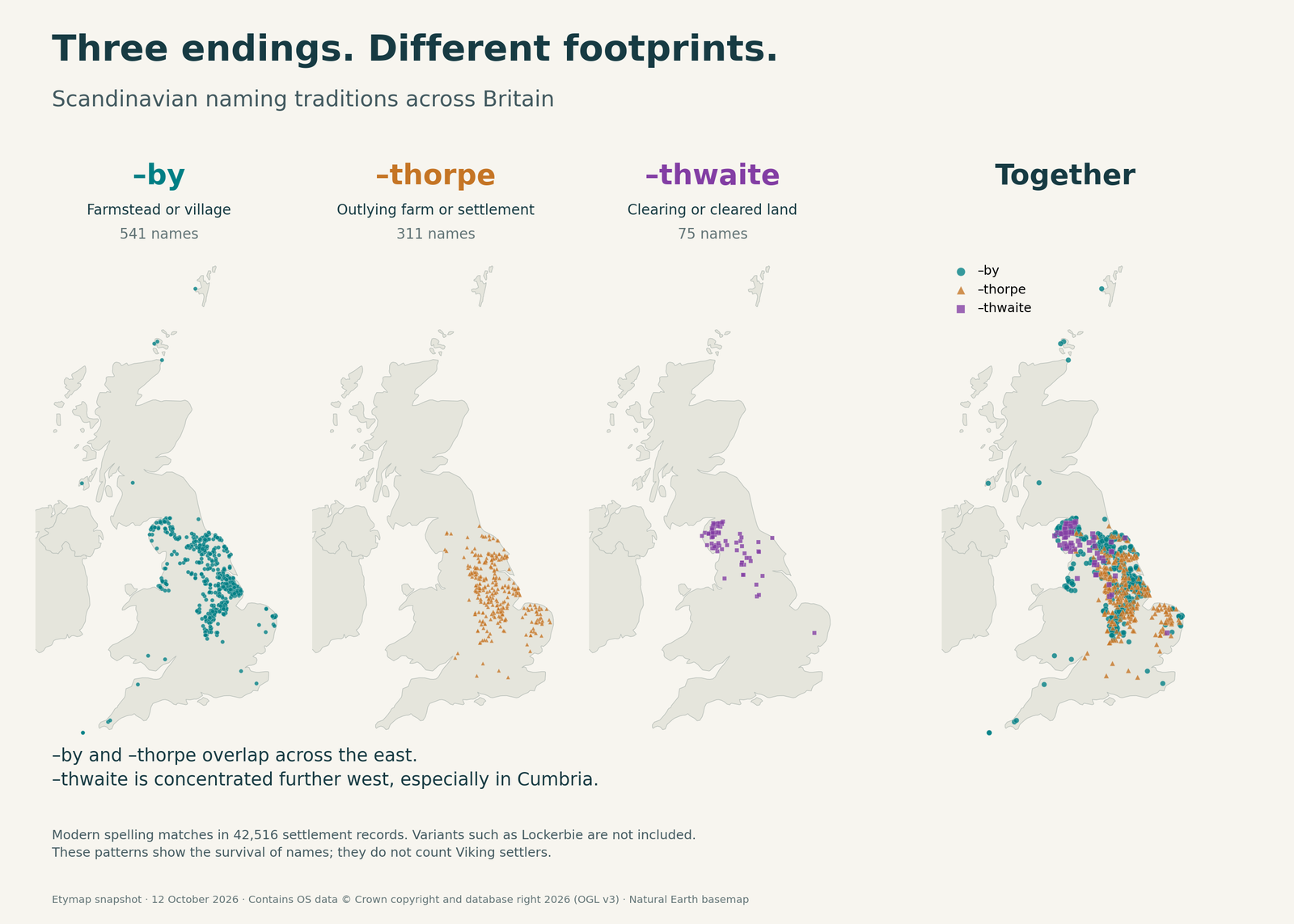
Our accompanying map uses 42,516 OS-labelled settlement records available through Etymap. Of 541 names ending exactly in -by, 194 fall within Lincolnshire, North Lincolnshire or North East Lincolnshire. These are modern spelling counts, not 194 independently verified Viking foundations. Even with that qualification, the concentration is striking.
Across the Pennines
Switch to -thwaite and the emphasis moves west. In the same dataset, 49 of 75 matches lie in Cumberland or Westmorland and Furness. The word derives from Old Norse þveit, meaning a clearing or a piece of cleared land.
This north-western pattern belongs to a wider Scandinavian geography reaching around the Irish Sea and into southern Scotland. It cannot be explained simply by colouring in the eastern English territories conventionally labelled “Danelaw”. Nor should every thwaite become a little Norwegian flag: closely related Scandinavian dialects, migration and later borrowing complicate that assignment.
The timing is equally slippery. In his study of [south-west Scottish names](https://open.journals.ed.ac.uk/ScottishStudies/article/download/227/253), W. F. H. Nicolaisen stressed that thwaite remained available for naming places for centuries. Its distribution can preserve the reach of a regional vocabulary long after the original settlers disappeared from view.
Lockerbie adds another complication. Its -bie belongs with -by, but Gillian Fellows-Jensen interpreted the first element as the continental personal name Lochard. She argued that names of this kind could reflect later tenants replacing part of an older name. A Scandinavian ending need not date every part of the name to the same century.
Her [study of Dumfriesshire and Galloway](https://www.ssns.org.uk/wp-content/uploads/2019/10/06_Fellows-Jensen_Galloway_1991_pp_77-96.pdf) also identifies a particular concentration in eastern Dumfriesshire. That is a more precise claim than calling the whole Scottish border country “Viking”.
The Vikings hiding in English endings
An apparent English name can conceal Scandinavian influence too. Toton, Nottinghamshire, combines the Norse personal name Tófi with Old English tūn. Gonalston and Thurgarton belong to the same broad family of mixed names.
These compounds are often called “Grimston hybrids”, though Nottingham researchers explain [why “Toton hybrids” can be a better label](https://emidsvikings.ac.uk/blog/two-languages-one-name-hybrid-place-names-in-the-east-midlands/): not every Grimston contains an unequivocally Scandinavian personal name. The names may record changing ownership, partial renaming or people drawing on both languages. They do not identify each inhabitant’s ancestry.
That matters when comparing -by with -ton. Old English tūn could denote an enclosure, farm or estate; hām, often surviving as -ham, a homestead; and lēah, behind many -ley names, woodland, a clearing or wood pasture. These were ordinary ways of describing inhabited and worked land, as [Etymap’s comparison of settlement names](https://www.etymap.co.uk/articles/farmsteads-fields-villages-settlement-suffixes) explores. English endings could survive under new owners.
Conversely, Scandinavian words could become ordinary local vocabulary. -toft, from a word for a house-site or farm plot, survives in Lowestoft. Kirk, associated with Old Norse kirkja, means church, but became established in Scots and northern English. The [historical Scots dictionary](https://www.dsl.ac.uk/entry/dost/kirk_n) even records early forms of Selkirk with chirche. Counting every Scottish kirk as a Scandinavian settlement would confuse a word’s ancestry with a place’s history.
What the dots leave out
[Whitby in Yorkshire](https://www.etymap.co.uk/place/whitby--osgb4000000074574457) is Scandinavian, but its first element has been interpreted as either “white” or the personal name Hvíti. Whitby in Cheshire presents a different problem: early spellings have supported an English origin subsequently reshaped under Scandinavian influence. Matching modern names need not have matching histories.
Historical linguist Paul Cavill uses examples like these to [challenge straightforward settlement maps](https://yugong.fudan.edu.cn/info/1521/29551.htm). A community that retained existing names can leave fewer obvious linguistic traces than one that named numerous small farms. Surviving spellings also depend on which documents were made, preserved and studied; a first written mention is not a foundation date.
The map therefore answers a narrower question well: where do particular naming traditions remain visible? It cannot count immigrants or draw an ethnic frontier. And its simplest omission is instructive: our exact -by search misses Lockerbie. Even before interpreting the history, we have to decide what we are looking for.